
16 Days of Activism
Turn awareness into action. Explore ways to help end gender-based violence and create safer communities for everyone.
Every year, from November 25 to December 10, people around the world come together for the 16 Days of Activism Against Gender-Based Violence, a campaign to eliminate all forms of violence against women and girls. This movement, initiated by UN Women, bridges the International Day for the Elimination of Violence Against Women (November 25) and Human Rights Day (December 10)—a poignant reminder that gender-based violence is a fundamental violation of human rights.
In Canada, this global campaign carries profound weight, particularly for Indigenous women, girls, and Two-Spirit people, who face disproportionate rates of violence. By participating in initiatives like the Moose Hide Campaign, we can take meaningful steps to address this crisis, support survivors, and advocate for justice.
Taking Action during 16 Days of Activism
- Read the Reclaiming Power and Place report, which outlines the systemic barriers and solutions for addressing violence against Indigenous women and girls, delivering 231 individual Calls for Justice directed at governments, institutions, social service providers, industries and all Canadians.
- Share what you learn with your network to spark meaningful conversations. Deepen your understanding of the MMIWG2S+ crisis by taking the We Are Medicine learning journeyExplore resources like the NWAC fact sheet on violence against Indigenous women to understand the scope of the crisis and its root causes.
- Wear the Moose Hide Pin
The moose hide pin is more than a symbol; it’s a pledge to end violence. Wearing it during the 16 Days—and beyond—shows your commitment to safety, equality, and justice. You can order pins for free through the Moose Hide Campaign’s website and encourage your friends, family, and colleagues to do the same. - Engage in Acts of Solidarity
The Moose Hide Campaign invites participants to fast for a day as an act of reflection and solidarity with survivors of violence. Consider taking part in this powerful tradition during the 16 Days of Activism and encourage others to join you. - Support Organizations Making a Difference
On Giving Tuesday (December 1, 2026), consider donating to the Moose Hide Campaign or organizations supporting MMIWG2S+ families. Financial contributions help fuel advocacy, education, and survivor support services. - Amplify the Voices of Indigenous Women and Two-Spirit People
Follow and support Indigenous-led organizations and activists who are advocating for change. Share their stories, artwork, and calls to action on social media to raise awareness about MMIWG2S+ and the importance of ending gender-based violence - Advocate for Systemic Change
Use your voice to call on governments, workplaces, and communities to implement the Calls to Justice outlined in the Reclaiming Power and Place report. This includes supporting legislative changes, increasing funding for survivor services, and addressing systemic inequalities that perpetuate violence.
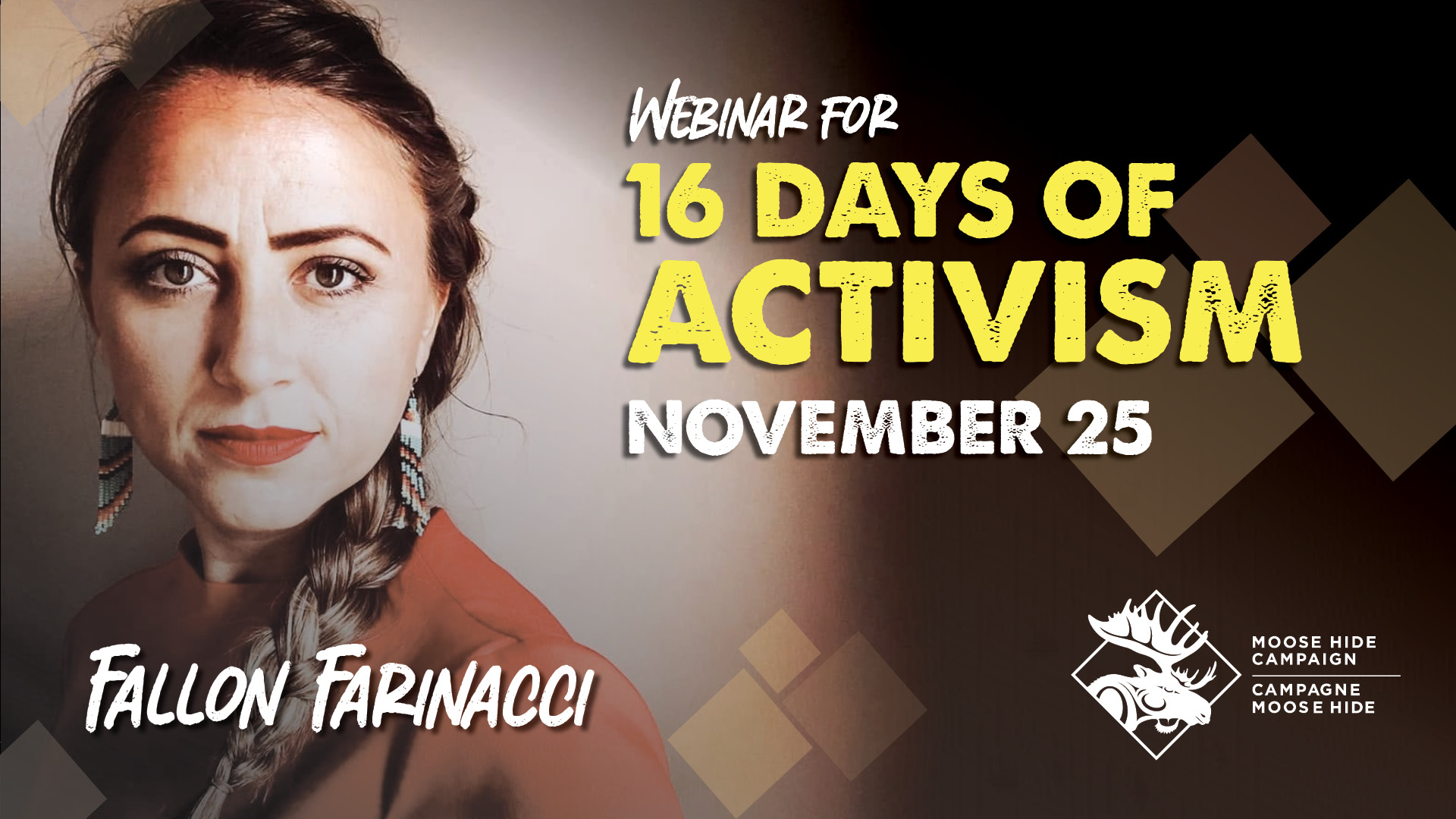
On the first day of the 16 Days of Activism against Gender-Based Violence, join us for a special conversation with Fallon Farinacci.
Fallon is a child survivor of the MMIWG2S+ crisis whose own family was profoundly impacted by violence. In 2017, she shared her story with the National Inquiry into Missing and Murdered Indigenous Women and Girls and later served on its National Family Advisory Circle. Today, she uses her voice and experiences to raise awareness, support healing, and advocate for change across Turtle Island.
Together, we’ll talk about the impacts of gender-based violence, the importance of survivor voices, and what it means to move from awareness towards meaningful action in our own lives and communities.

Every day people share with us what the Moose Hide Campaign means to them. So we asked theM to write in. These are their words.
The History of the 16 Days of Activism
Women’s rights activists have observed 25 November as a day against gender-based violence since 1981. This date was selected to honour the Mirabal sisters, three political activists from the Dominican Republic who were brutally murdered in 1960 by order of the country’s ruler, Rafael Trujillo (1930-1961).
On 20 December 1993, the General Assembly adopts the Declaration on the Elimination of Violence against Women through resolution 48/104, paving the path towards eradicating violence against women and girls worldwide.
Finally, on 7 February 2000, the General Assembly adopts resolution 54/134, officially designating 25 November as the International day for the Elimination of Violence Against Women and in doing so, inviting governments, international organizations as well as NGOs to join together and organize activities designed to raise public awareness of the issue every year on that date.
For Indigenous women in Canada, these 16 days also highlight the ongoing national crisis of Missing and Murdered Indigenous Women, Girls, and Two-Spirit People (MMIWG2S+), rooted in systemic racism, colonial violence, and socio-economic inequities. Reports like Reclaiming Power and Place have shed light on this tragedy, providing calls to justice to address and prevent violence against Indigenous communities.